The Australian mining sector—an engine of global commodity supply—is now defined by two non-negotiable mandates: sustained output and unyielding safety integrity. We are entering a new phase of regulatory reality, marked by rapidly escalated penalties, criminalized negligence, and the formal inclusion of emerging hazards like psychosocial risk. The industry’s response must be a comprehensive digital transformation, with digital procurement leading the way in making safety controls auditable.
Crucially, the seemingly administrative function of procuring essential Work Health and Safety (WHS) equipment, from simple consumables to complex Personal Protective Equipment (PPE), has fundamentally shifted. It is no longer a logistical back-office task; it is now an indispensable component of an organization’s demonstrable WHS strategy. Specialized platforms like Get Workgear are at the vanguard of this evolution.
This analysis details the confluence of stricter WHS legislation, the expanding scope of risk management (including psychosocial hazards), and explains how dedicated digital procurement platforms are moving past purchase facilitation to become essential compliance and safety assurance tools.
Table of Contents
- Part I: Navigating the New High-Stakes WHS Landscape
- Part II: Digital Procurement as a Compliance Engine
- Part III: The Future Integration – AI, Digital Twins, and Next-Gen Safety
- Conclusion: Securing the Future of Mining Operations
Part I: Navigating the New High-Stakes WHS Landscape
While mining has always been a high-risk operational environment, recent legislative amendments have entirely reset the risk-reward calculation for corporate entities. The antiquated reliance on manual, reactive safety checks is obsolete; the current focus—driven by government mandate—is on proactive, systemic risk mitigation, supported by dramatically escalated penalties.
A. The Unprecedented Escalation of WHS Penalties
The most profound legislative shift is the annual indexation and steep increase in maximum monetary penalties under the Commonwealth Work Health and Safety Act 2011 (WHS Act).
Financial Catastrophe (2024-2025):
Effective from 1 July 2024, penalties for Category 1 Offences now breach multi-million dollar figures, surpassing the $10 million threshold in many jurisdictions. This is not simply a fine; it represents a clear legislative intent to criminalize systemic safety failures that lead to death or serious injury, posing an existential risk to the balance sheet.
The Officer Accountability Doctrine:
Corporate officers (directors and executives) now face staggering individual penalties, directly reinforcing their personal duty of due diligence. They have no insulation from safety failures that occur at the operational level.
The reality is that the financial fallout from a single catastrophic safety breach now inherently outweighs the capital expenditure required to implement sophisticated digital WHS and procurement controls. This is an insurance premium against insolvency.
B. The Integration of Psychosocial Hazard Management
Arguably the most complex frontier of modern WHS is the mandate to formally manage psychosocial risks. Following amendments to the WHS Act and subsequent Codes of Practice across jurisdictions like NSW and WA, Persons Conducting a Business or Undertaking (PCBUs) in mining must now proactively manage these hazards, which is a clear extension of their primary duty of care. For official regulatory guidance, refer to Safe Work Australia’s information on Psychosocial Hazards.
Mandatory hazards that must be managed include:
- Isolation and Fatigue: The recognized strain and risk associated with Fly-In, Fly-Out (FIFO) and other remote or isolated work arrangements.
- Organisational Stressors: Excessive job demands, highly controlled environments, and a lack of autonomy in task execution.
- Harmful Culture: Bullying, harassment, and poor organisational justice.
Effective management of these risks demands the same systematic, evidence-based rigor applied to physical hazards. Failure to establish an auditable system for this is a clear and demonstrable breach of a PCBU’s primary duty of care.
Part II: Digital Procurement as a Compliance Engine
In this elevated compliance environment, the procurement of Uniforms and PPE – which function as essential safety controls – must be digitally integrated to satisfy legal duties. A modern digital procurement platform does not merely process a transaction; it must actively enforce WHS policy and provide a continuous, auditable compliance trail.
A. Get Workgear: How Digital Procurement Transforms Policy into Logic
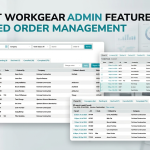
Get WorkGear operates as a specialized platform, designed specifically to manage the complexity of B2B safety gear supply. Its core features convert reactive administrative processes into proactive safety controls:
1. Role-Based Allocation and Policy Enforcement:
This is the critical safety mechanism.
- The Flaw: Traditional procurement is inherently prone to human error, relying on managers to manually verify the correct gear for highly specific roles (e.g., a welder versus a mine site visitor).
- The Digital Mandate: Get WorkGear’s Role Engine links an employee’s job title (e.g., “Underground Diesel fitter”) to a mandatory, pre-approved product list. The system restricts the order stream, ensuring the employee can only select the precise PPE, Hi-Vis rating, and fire-resistant garment that complies with the safety protocol. It instantly enforces compliance with AS/NZS standards and internal WHS policies. Learn more about implementing Get Workgear’s compliance functions by contacting our team.
B. Auditable Spend and Accountability through Digital Procurement
The platform integrates hard budget and quantity limits per employee and per role.
- Compliance Certainty: By tying expenditure directly to safety allocations, the system generates real-time, irrefutable reports detailing mandatory PPE dispersal. This data is invaluable during a safety audit, providing instant, documented proof that the PCBU has fulfilled its duty to provide necessary safety equipment.
C. Multi-Level Approval Workflows and Digital Procurement Audits
Customisable, digital approval workflows ensure that any purchase deviating from the standard or exceeding an allowance requires a digitally signed sign-off from an authorized manager. This establishes a clear, documented chain of accountability for every safety control purchased.
Part III: The Future Integration – AI, Digital Twins, and Next-Gen Safety
The digital transformation trajectory in mining is moving toward a single, fully integrated operational and WHS ecosystem. Procurement data is positioned to become an essential intelligence source for this future.
A. Using Digital Procurement Data for Predictive Safety Insights
The logical evolution for platforms like Get WorkGear is deep integration with broader operational and WHS systems:
- Wearer Compliance Alerts: Imagine a system that uses procurement data to flag an anomaly: a miner’s profile indicates they have not re-ordered their mandatory safety boots or gloves within the required 12-month lifecycle. This data triggers an automated WHS alert to the site safety officer, proactively closing a compliance gap before a catastrophic event occurs.
- Predictive Procurement: By correlating consumption data (procurement) with incident data (WHS logs), an AI model can identify non-obvious correlations. For example, if a specific pattern of hand injury is observed, the procurement system can automatically recommend or increase the allowance for specialized, higher-rated gloves for the exposed workgroup.
B. Leveraging Digital Procurement Data with Digital Twins
The Australian mining sector is a key investor in Digital Twin technology—virtual, real-time models of assets and operations. This provides a revolutionary new application for integrating PPE and uniform data:
- Immersive Training Fidelity: Digital twins allow for immersive training in a safe, virtual environment. Procurement data can feed the twin, ensuring the worker’s avatar is wearing the exact compliant PPE model and branding used in the physical mine. This elevates training realism and reinforces critical safety procedures.
- Simulated Risk Management: By combining real-time asset tracking with PPE data, the digital twin can simulate and test safety scenarios. An integrated AI can flag a scenario where a worker in a specific zone is not wearing the required Hi-Vis level (as recorded by the procurement system), using this to train and validate remote operations staff.
Conclusion: Securing the Future of Mining Operations
The digital procurement platform, exemplified by specialized systems, has fundamentally transcended its utility as an efficient ordering tool. Within the context of Australia’s high-stakes WHS regulatory environment, it has become a fundamental pillar of corporate governance and safety assurance.
The convergence of legislative pressure (multi-million dollar penalties), complex new risk mandates (psychosocial hazards), and the acceleration of technology adoption (AI and Digital Twins) means that managing PPE through manual, paper-based systems is no longer tenable. For Australian mining companies and their officers, implementing a centralised, automated, and auditable digital procurement platform is not merely an operational refinement; it is a demonstrable act of due diligence that protects the workforce, mitigates catastrophic liability, and secures the financial viability of the entire operation. The future of mining safety is unequivocally digital and inextricably linked to every compliant item ordered through a smart system.


Published on Thursday, 16 October 2025 under Industries.